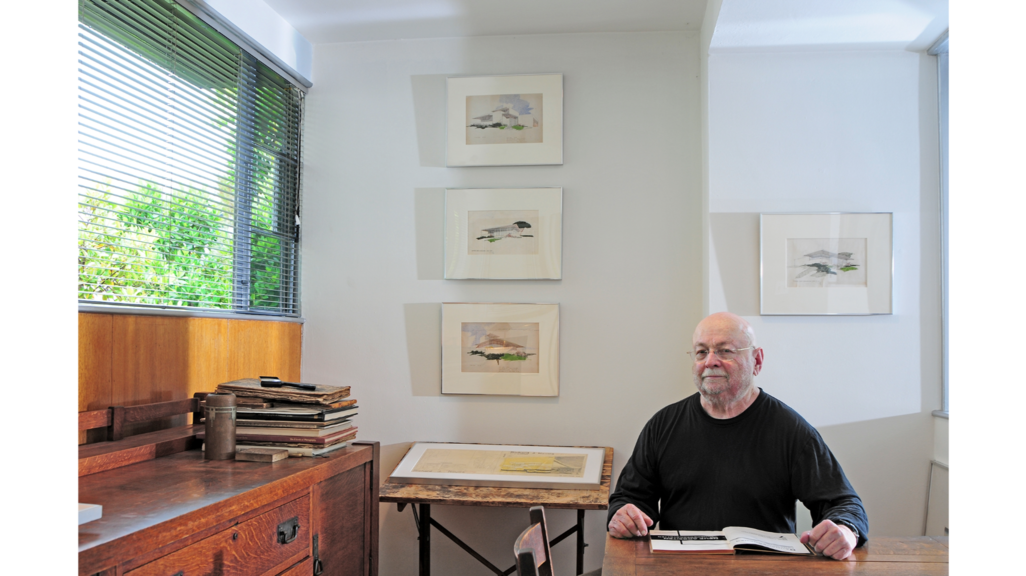
Remembering Thomas Hines, 1936-2026
Jul 30, 2026
Thomas Spight Hines Jr., Professor Emeritus of History and Architecture at UCLA, died on July 26 at the age of 89.
For more than five decades, Hines was a formative presence at UCLA, where he held the rare distinction of a joint appointment spanning the Department of History and the Department of Architecture and Urban Design. Interdisciplinary in all senses of the term, his scholarship and teaching are credited with reshaping how we view modern architecture, especially the architecture of Southern California, and with encouraging designers to look past labels and ask what a building was truly doing in the world.
“Few historians have had a comparable impact on how architects, scholars, and the public understand modern American architecture,” Architect magazine observes in its remembrance of Hines. “Through landmark biographies of figures including Daniel Burnham, Richard Neutra, and Irving Gill, Hines reshaped architectural history from a discipline centered on style into one equally concerned with reform, culture, urbanism, and ideas.”
Hines is also remembered as a warm, generous mentor invested in student growth and the power of research. Last year, Mary Melton (BA ‘91, History) shared with UCLA Magazine that Hines “challenged everything I thought I knew about my hometown of Los Angeles — and determined my future in the process.”
“He treated his college students like full-grown adults, and it’s something I’ve been able to thank him for in person more than once.”

Born in Oxford, Mississippi, in 1936, Hines earned his bachelor's degree from the University of Mississippi in 1958 before heading to the University of Wisconsin–Madison, where he completed a Ph.D. in history in 1971. His dissertation on the architect and planner Daniel Burnham became the basis for his first book, Burnham of Chicago: Architect and Planner (1974), which won the American Historical Association's John H. Dunning Prize and helped restore Burnham's standing as a defining figure in American architecture and planning.
That same year, Hines joined UCLA's faculty, the academic home he would hold for the rest of his career.
His 1982 study of Richard Neutra, Richard Neutra and the Search for Modern Architecture, went further than a conventional design biography; it examined Neutra as a figure grappling with immigration, technology, and the promises and contradictions of modern life in America. The book remains a standard reference on the Austrian-born Neutra, and on California modernism.
Hines’s 2000 book, Irving Gill and the Architecture of Reform, recast Gill from a regional curiosity into one of the earliest and most intellectually serious modernists working in the United States, tracing his stripped-down design language back to progressive-era social reform and public health movements. Following Hines's death, the Irving J. Gill Foundation called the book a foundational text that permanently changed how Southern California's built environment is understood, and remembered Hines himself for his generosity as much as his scholarship.
Alongside these biographies, Hines's essays on Los Angeles, Wilshire Boulevard, and figures like John Cage advanced the study of California architecture during a time when theorists and critics fixated largely on the East Coast. His honors included a Guggenheim Fellowship in 1987 and election to the American Academy of Arts and Sciences in 1994. His papers are held at the Getty Research Institute.
“His greatest legacy may not simply be the remarkable books he left behind,” Architect magazine notes, “but the generations of architects, historians, and readers who now see American modernism—and particularly the architecture of California—with greater depth, complexity, and appreciation because of his work.”